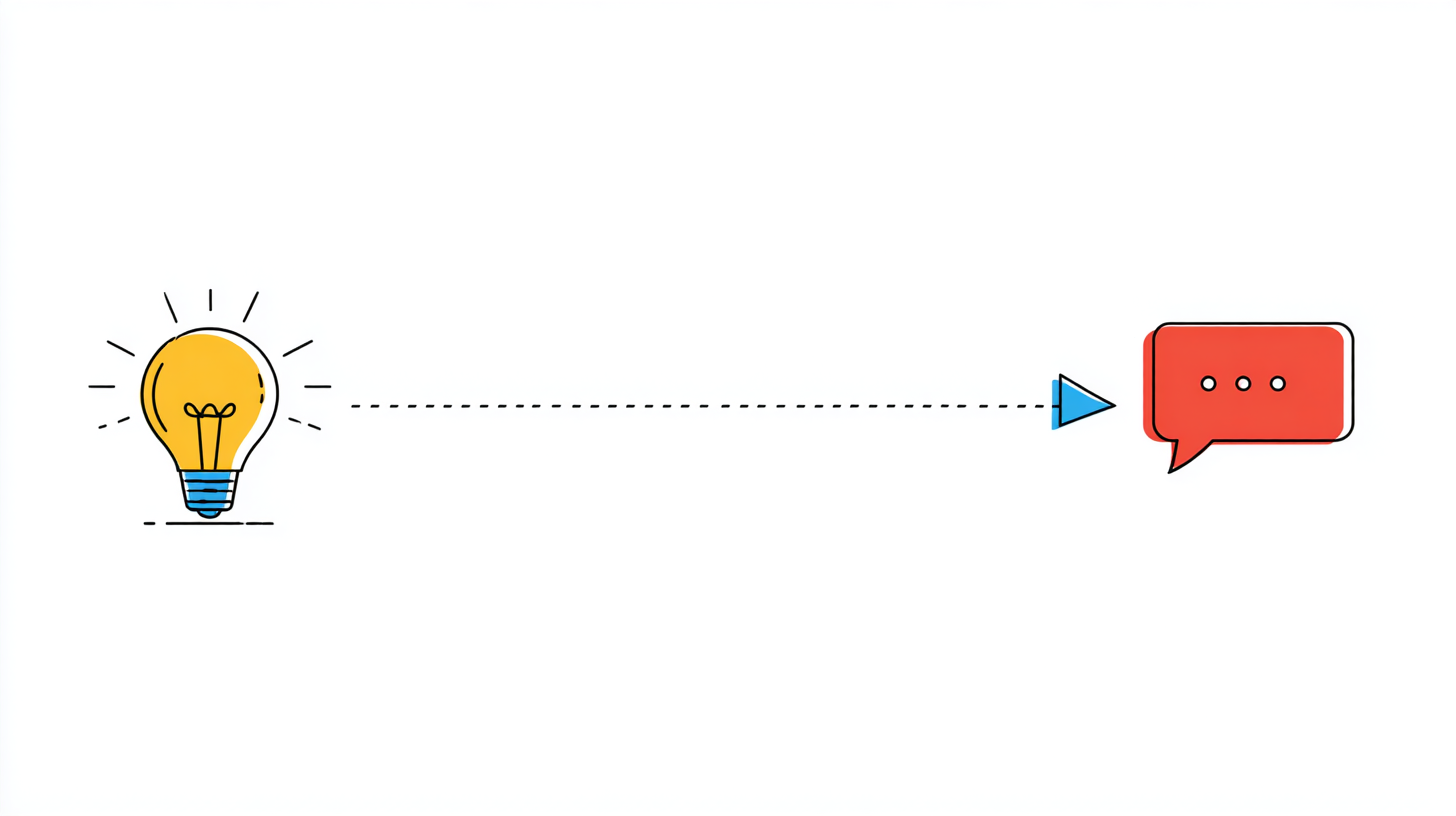
Every line in every Outputly song follows the same pattern. You hear your native language first. Then a recall gap. Then the target language.
"I want a coffee" (recall gap) ... quiero un café "Where is the restaurant?" (recall gap) ... ¿dónde está el restaurante?
This isn't a style choice. It's a deliberate design decision based on how your brain produces speech. And reversing the order would make the songs significantly less effective.
What Happens When You Speak
When you speak a foreign language in real life, the process always starts the same way. You have a thought or a meaning in your mind — something you want to express. That thought exists in your native language, or more accurately, as a concept that your native language gives shape to.
Then your brain has to find the words in your target language that express that thought.
This is the production pathway: meaning → target language. You start with what you want to say and search for how to say it.
Now consider the reverse. When you hear someone speak your target language, the process goes the other direction: you hear the foreign words and search for the meaning. This is the comprehension pathway: target language → meaning.
These two pathways are different brain processes. Training one doesn't automatically train the other. And this is where most methods make a critical mistake.
Why Most Methods Train the Wrong Direction
Traditional flashcards and many language apps show you the target language first and ask you to recognise the meaning. You see "quiero" and think "I want." You hear "dónde está" and understand "where is."
This trains comprehension — the ability to understand when someone speaks to you. It's target language → meaning. And it's useful. Comprehension matters.
But it doesn't train production. When you're in a conversation and you want to say "I want a coffee," your brain doesn't start from "quiero." It starts from the meaning — the thought "I want a coffee" — and needs to find "quiero un café."
If you've only practised recognising "quiero" when you see it, your brain has a strong pathway from "quiero" → meaning. But the reverse pathway — meaning → "quiero" — is weak or nonexistent. You can understand the word when you hear it but you can't produce it when you need it.
This is why so many learners can understand a language but can't speak it. They've trained comprehension thousands of times and production almost never.
The Revised Hierarchical Model
Research by Kroll and Stewart (1994) established what they called the Revised Hierarchical Model of bilingual memory. Their research showed that the connections between your native language and your target language are asymmetric — stronger in one direction than the other.
Specifically, the connection from your native language to meaning is very strong (you've had it your whole life). And the most efficient route to produce target language speech goes through that native language connection.
When you want to say something, your brain accesses the meaning through your native language first, then maps it to the target language. This is especially true for learners who aren't yet fully fluent. The native language acts as a bridge to the target language.
Training the production direction — native language → target language — strengthens this bridge. Training the reverse direction — target language → native language — strengthens comprehension but leaves the production bridge weak.
How Outputly Uses This
Every Outputly song presents your native language first, followed by a recall gap, followed by the target language.
This sequence trains the exact pathway your brain uses in real speech:
You hear the meaning in your native language ("I want a coffee")
During the recall gap, your brain searches for the target language
The target language arrives ("quiero un café") and confirms or teaches the correct production
On early listens, step 2 is passive — your brain hears the meaning and then receives the target language. It's absorbing the connection.
On later listens, step 2 becomes active — your brain hears the meaning and tries to produce the target language before it arrives. The recall gap becomes a production test.
Eventually, step 2 becomes automatic — your brain hears "I want a coffee" and "quiero un café" comes out instantly, without conscious retrieval. The production pathway is established. The chunk is in your Knowing Brain.
If the song showed the target language first and your native language second, you'd be training comprehension. You'd get better at understanding "quiero un café" when you hear it. But you wouldn't develop the ability to produce it from a meaning or thought.
The direction matters. Native language first trains production. Target language first trains recognition. Outputly trains production — because production is speaking.
Why This Works Across All Languages
This principle isn't specific to any single language. Whether you're an English speaker learning Spanish, a Spanish speaker learning English, a French speaker learning German, or any other combination — the production pathway always starts from the speaker's native language.
That's why every Outputly product follows the same pattern. The learner's native language comes first. Always. The recall gap follows. Then the target language arrives.
For spanish.outputly.io, the songs show English → Spanish. For ingles.outputly.io, the songs show Spanish → English. For any future language pair, the native language leads.
The method doesn't change. The direction of training doesn't change. Only the languages change.
The Recall Gap Completes the Picture
The recall gap between the native language and the target language isn't empty space. It's the most important moment in the song.
During that gap, your brain is doing exactly what it would do in a real conversation: it has a meaning it wants to express, and it's searching for the words to express it. The gap simulates the production moment.
On early listens, the gap is just a pause before the answer arrives. Your brain is learning the connection.
On later listens, the gap becomes a challenge. Your brain races to produce the target language before it plays. Sometimes you get it. Sometimes you don't. But there's no penalty for failing — the song gives you the answer immediately and moves on.
On mastered chunks, the gap disappears. The target language comes out of your mouth before the song even plays it. You've internalised the production pathway. The chunk is automatic.
Learning Mode extends this gap, pausing the song so you can take as long as you need. If the target language comes out instantly — no assembly, no hesitation — it's in your Knowing Brain. If you have to think about it, it's still in your Thinking Brain. Relisten. The transfer will come.
About Outputly
Every Outputly song puts your native language first because that's how your brain produces speech. The recall gap trains the production pathway. Learning Mode tests it. And the earworms reinforce it involuntarily throughout your day.
We don't train you to understand. We train you to speak.