Apple once said the best camera is the one you have with you. It didn't matter that a professional DSLR took sharper photos. If it was sitting at home when the moment happened, it was useless. The phone in your pocket — always there, always ready — captured more great photos than any expensive camera gathering dust.
Language learning works the same way.
The best method isn't the most scientifically optimised. It isn't the one with the most features. It isn't the one that costs the most or has the best reviews. The best method is the one you actually use. Consistently. Daily. Without having to think about it.
And that means the best method is the one that fits into the life you already live.
The Myth of the Study Session
Most language learning methods require you to sit down and study. Open the app. Start the lesson. Focus. Concentrate. Engage.
This assumes you have a spare thirty minutes of focused attention every day. It assumes you're not tired, not distracted, not busy. It assumes you'll choose study over Netflix, over scrolling, over doing nothing.
Some days you will. Most days you won't.
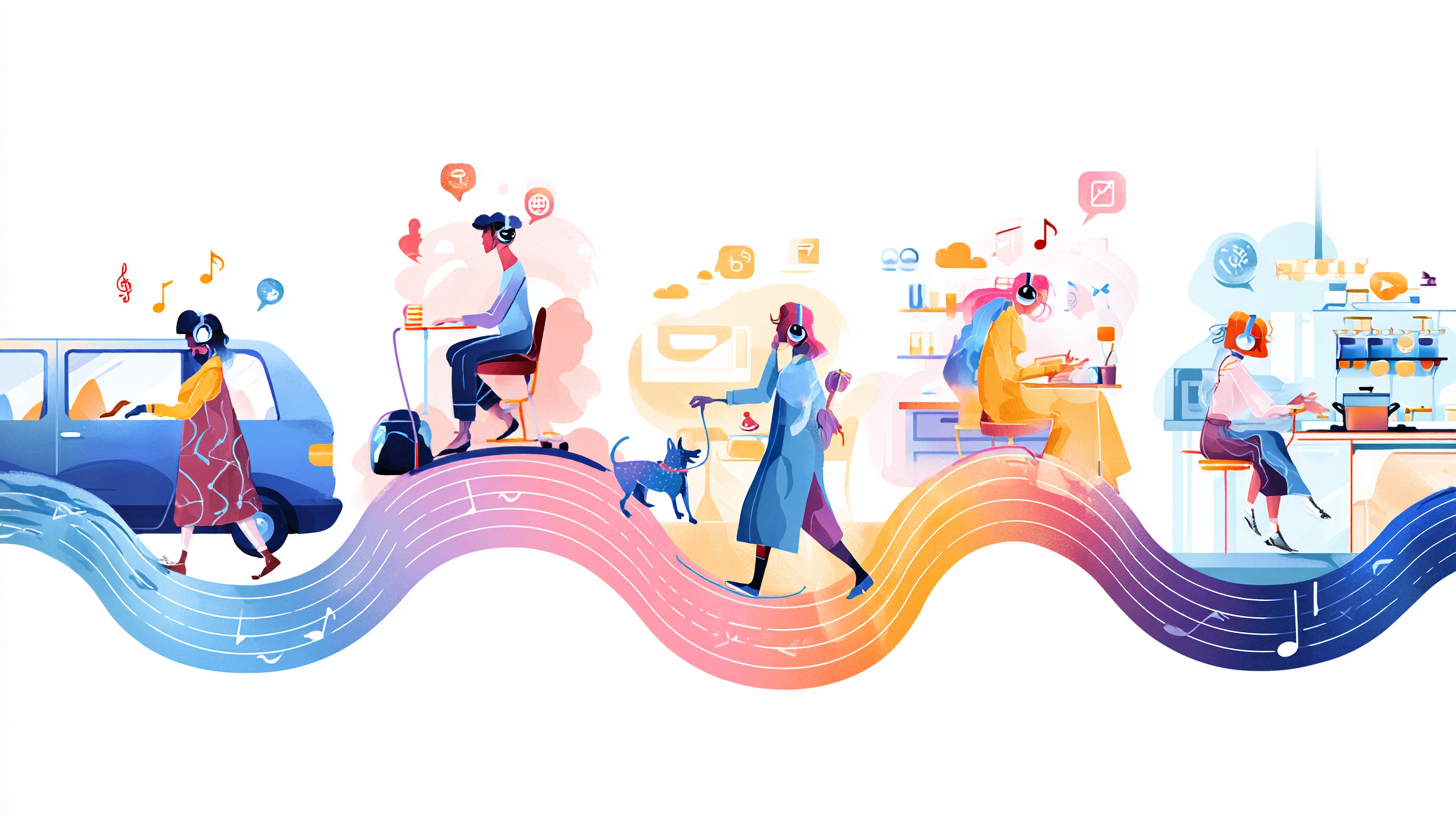
Life doesn't have a study-shaped gap in it. You're commuting. You're cooking. You're waiting at the dentist. You're walking the dog. You're stuck in traffic. You're on a train. You're at the gym. You're folding laundry.
These aren't gaps in your day. They're your day. And they're filled with time your brain is doing almost nothing.
The Hidden Hours
Think about your average day and count the time your ears are free:
The commute — fifteen minutes? Thirty? An hour? Whether you're driving, on the bus, on the train, or walking, your ears are available.
Waiting — at the doctor's office, in a queue, for a meeting to start, for your coffee. These five and ten minute pockets add up.
Household tasks — cooking, cleaning, ironing, washing up. Your hands are busy but your brain is idle.
Exercise — walking, running, gym. Most people already listen to music during these activities.
Errands — grocery shopping, driving to appointments, picking up the kids.
Add it up. For most people, it's two to three hours per day where their ears are free and their brain is available. That's fourteen to twenty-one hours per week. Over a month, that's sixty to ninety hours.
Sixty to ninety hours of potential language exposure per month. Sitting there. Unused. Every month.
No study session required. No dedicated time carved out of your schedule. No willpower needed to sit down at a desk. Just the hours you're already spending doing other things.
Why Most Methods Can't Use This Time
Duolingo needs your eyes and your hands. You can't use it while driving, cooking, or walking. It requires a screen, focused attention, and interaction.
Textbooks need you sitting at a desk. Classes need you in a room at a specific time. Flashcards need your phone screen. Even comprehensible input videos need your eyes.
Most language learning is designed for dedicated study sessions. It can't travel with you. It can't fit into the margins of your day. It sits on your phone waiting for a moment of free time that rarely comes.
And when it does come, you're tired. So you don't open the app. And another day passes.
Language Learning That Lives in Your Pocket
Music is different. Music goes everywhere you go. It plays through the same headphones you're already wearing, through the same phone that's already in your pocket, during the same activities you're already doing.
When your language learning songs sit in a playlist you can put on like any other, something fundamental changes: the barrier to learning drops to zero.
Driving to work? Your learning is playing through the car speakers.
Walking the dog? Your learning is in your headphones.
At the gym? Your learning is in your workout playlist.
Cooking dinner? Your learning is playing from your kitchen speaker.
Waiting for a train? Your learning is already queued up.
You don't open a special app. You don't switch to study mode. You don't carve out time. You just press play on the platform you already use, during the time you're already spending.
Frequency Beats Intensity
Language acquisition research consistently shows that frequency of exposure matters more than intensity. Ten minutes a day for thirty days produces better results than five hours in a single session.
Your brain needs repeated encounters with language to consolidate it. Each time you hear a phrase, the neural pathway strengthens slightly. Enough encounters over enough days, and the pathway becomes automatic. The phrase moves from your Thinking Brain to your Knowing Brain.
This is why the hidden hours matter so much. If you listen to your language learning songs during your commute (thirty minutes), while cooking (twenty minutes), and during a walk (twenty minutes), that's over an hour of exposure in a single day — spread across three natural touchpoints.
And here's what makes music uniquely powerful for frequency: you don't get bored of it.
You'll happily listen to the same playlist for weeks. You'll replay a favourite song dozens of times. Each replay is another exposure, another repetition, another small strengthening of the neural pathway. And it never feels like studying.
Try replaying the same flashcard deck every day for a month. You'll abandon it in a week. Try replaying the same playlist every day for a month. You won't even think about it.
The Earworm Advantage
But the real magic isn't even the active listening. It's what happens after you stop.
When a song is catchy enough to become an earworm, it loops in your head involuntarily. You take your headphones off after your commute, but the song keeps playing. In a meeting. At your desk. During lunch. In the shower before bed.
Research by Williamson et al. (2012) found that the vast majority of people experience earworms regularly. These involuntary loops can persist for hours, sometimes all day.
If your earworm contains phrases in your target language, your brain is rehearsing speech production throughout the day — without headphones, without a phone, without any conscious decision to study. Your Feeling Brain tagged the song as rewarding, and now it keeps replaying it on a loop, pushing the language from your Thinking Brain to your Knowing Brain.
This means your actual language exposure isn't just the two to three hours you spent listening. It's those hours plus every minute the earworm loops in your head. For a particularly catchy song, that could double or triple your effective exposure.
No other learning method can follow you into a meeting, a shower, or a dream. Earworms can.
The Compound Effect
Think about where it would actually sit in your day.
A commute. A walk at lunch. The playlist on while dinner cooks. None of that is time you have to find — it is time that already exists, currently soundtracked by something else.
On top of that the choruses keep returning by themselves, through the parts of the day you were not listening at all.
That's ninety-five minutes of total language exposure per day. Without a single dedicated study session. Without any willpower. Without ever feeling like you're learning.
Over a week, that's eleven hours. Over a month, roughly forty-five hours. Over three months, one hundred and thirty-five hours.
Compare that to a Duolingo user who manages fifteen minutes of dedicated study per day (which is generous — most users do five to ten minutes). That's seven and a half hours per month. Forty-five hours over six months.
The music-based learner accumulates in one month what the app-based learner accumulates in six. Not because they're more disciplined. Because the method fits into time they were already spending.
It Doesn't Feel Like Work
This is the point that changes people's relationship with language learning.
Every other method feels like an obligation. Open the app. Do the lesson. Maintain the streak. Review the cards. It's homework. And like all homework, you'll avoid it when you're tired, busy, or unmotivated.
Listening to music doesn't feel like anything. It's just music. You're driving and songs are playing. You're walking and music is in your ears. You're cooking and a playlist is on. At no point does your brain register this as "studying." There's no resistance. There's no guilt. There's no "I should be learning right now but I'm not."
Because you are learning. You just don't feel it.
The Spanish phrases are entering your ears, activating your Feeling Brain, forming earworms, and transferring language to your Knowing Brain. All while you think you're just listening to music on your commute.
Every Day Is a Language Day
When your learning lives in a playlist you already have on, you never have a zero day. Even on your busiest, most stressful, most exhausting day, you're going to listen to some music. In the car. On a walk. While getting ready.
You don't have to decide to learn. You don't have to find time. You don't have to summon motivation. The learning happens because the music is already playing during time you were already spending.
The best language learning method isn't the most advanced. It's the one that's always with you — in your pocket, in your headphones, on your car speakers — ready to teach you while you live your life.
The best method is the one you actually do.
About Outputly
Every Outputly song lives in the Outputly app. Learn through our lyric videos, then take the songs with you everywhere — your commute, your gym, your kitchen, your walk. Every relisten reactivates your Feeling Brain and pushes more language from Thinking to Knowing.
No study sessions. No dedicated time. No willpower. Just songs that teach you to speak while you live your life.