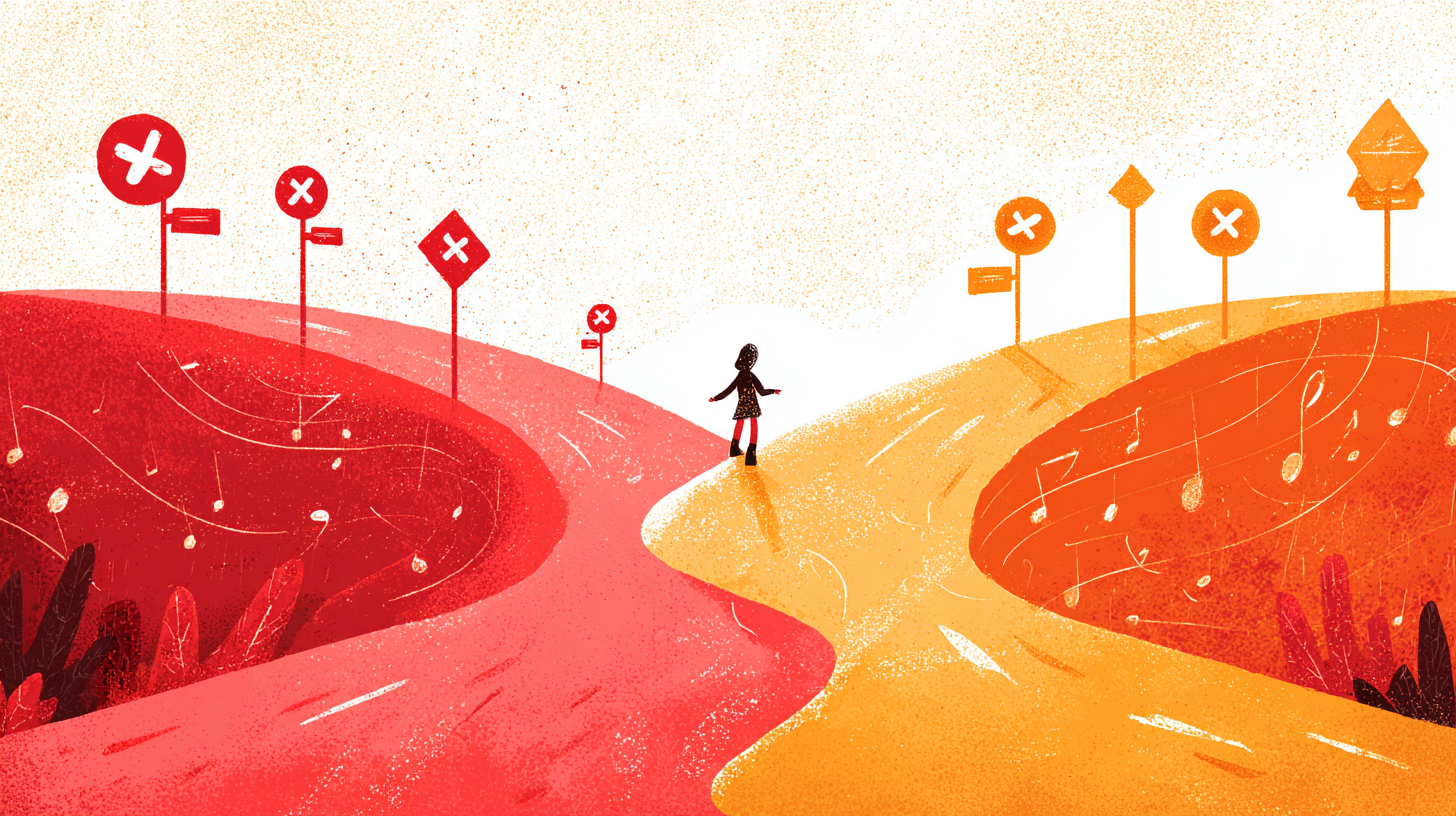
Flip a flashcard. "Hablar." You know this one. Wait. Is it "to speak"? Or "to talk"? Both? You hesitate. The card flips. Red. Wrong. You got it wrong.
A tiny sting. A small internal flinch. Not painful — just enough to register. You got it wrong. You should have known that. You studied it yesterday.
Next card. "Conseguir." You don't know this one at all. You guess. Wrong again. Another red mark. Another flinch.
By the tenth wrong answer, something has shifted. You're not learning anymore. You're defending. Every card feels like a test. Every flip is pass or fail. Your shoulders are tight. Your jaw is clenched. You're not thinking about Spanish — you're thinking about how many you're getting wrong.
You close the app. You'll try again tomorrow.
Now imagine a different experience. A song starts playing. You catch some words. You sing along to the bits you recognise. The chorus comes around and you nail a whole phrase. The verse starts and you mumble through it. The chorus comes back and you sing it louder.
Nobody scored you. Nobody marked anything red. You didn't get anything "wrong" because there was nothing to get wrong. You just sang what you could and let the rest wash over you. And when the song plays again tomorrow, you'll catch a little more.
That difference isn't just about enjoyment. It's about how your brain learns.
The Neuroscience of Failure
When you get a flashcard wrong, something specific happens in your brain. The anterior cingulate cortex — the region that monitors errors — fires a signal. This error signal triggers a mild stress response. Cortisol levels increase slightly. Your amygdala — the brain's threat detector — takes note.
One wrong answer is negligible. But flashcard sessions involve dozens of wrong answers in a row. Each one adds a small stress signal. Over a fifteen-minute session, the cumulative effect is significant: your brain shifts into a mildly defensive state.
In this state, your Thinking Brain is still functional — you can still recall facts. But your Feeling Brain withdraws. The pleasure and reward pathways that accelerate learning go quiet. And your Knowing Brain — the procedural memory system that handles automatic production — stops forming new connections.
Your brain is protecting itself from a perceived threat (repeated failure) rather than building new skills. Learning slows. Transfer from Thinking to Knowing stalls. And the experience becomes associated with stress rather than reward.
Do this enough times and your brain forms a simple association: language study equals discomfort. Not dramatic anxiety — just a low-grade aversion that makes you reach for Netflix instead of the flashcard app when you have free time.
The Binary Trap
The fundamental design of flashcards creates a binary world: right or wrong. Correct or incorrect. Green or red. Pass or fail.
There's no middle ground. You either know the word or you don't. There's no credit for "I sort of know this." There's no acknowledgement of "I'd recognise this in context but can't produce it from scratch." There's no space for "this is on the tip of my tongue."
This binary framework doesn't match how language actually works. In real life, language knowledge exists on a spectrum. You might understand a word when you hear it but not be able to produce it. You might produce it slowly but not at conversational speed. You might use it correctly in one context but not another.
Flashcards collapse all of this nuance into a single question: do you know it or not? And if the answer is "not perfectly," you've failed.
This creates a distorted relationship with your own progress. Every review session reminds you of what you don't know. The pile of "failed" cards grows. The app tells you how many are overdue. You start to feel like you're falling behind — even when you're actually learning.
The guilt accumulates. "I should be reviewing my cards." "My deck is out of control." "I keep getting the same ones wrong." Language learning becomes something you're failing at rather than something you're progressing through.
Why Songs Have No Wrong Answers
A song doesn't test you. It invites you.
When a chorus comes around and you sing along, nobody checks whether you pronounced every syllable correctly. When you mumble through a verse because you don't know the words yet, nothing turns red. When you miss a line entirely, the song doesn't stop and make you try again.
You simply participate at whatever level you're at. You sing the bits you know. You listen to the bits you don't. And the song moves on.
This isn't passive. Your brain is still processing the language. Your ears are hearing the pronunciation. Your mouth is attempting the sounds it can manage. Your Feeling Brain is engaged because the music is pleasurable. Learning is happening — just without the surveillance and judgement of a testing system.
And here's what matters: the song will come back. You'll hear it again tomorrow. And the day after. And the day after that. Each time, you'll catch a little more. The verse you mumbled through last week becomes a verse you half-sing this week. The line you couldn't catch becomes a line you anticipate.
Progress happens through repetition and exposure, not through testing and correction. And because there's no failure state, there's no anxiety building up, no aversion forming, no guilt accumulating.
The Permission to Be Imperfect
There's something psychologically powerful about a method that doesn't expect perfection.
Flashcards implicitly say: "You should know this." Every wrong answer is a reminder that you don't. The system is designed around your deficiencies — it shows you what you've failed and demands you fix it.
Songs implicitly say: "Join in when you're ready." There's no expectation that you'll sing every word correctly on the first listen. Or the fifth. Or the tenth. You're not being measured against a standard. You're just participating in music.
This permission to be imperfect changes your relationship with the language. You stop seeing it as something to be studied and tested. You start seeing it as something to be experienced and absorbed. The pressure lifts. The guilt dissolves. And paradoxically, you learn faster.
Research consistently shows that learning in a relaxed, positive emotional state produces better outcomes than learning under stress. When your Feeling Brain is engaged and your stress response is quiet, memories form faster, consolidate deeper, and transfer to procedural memory more efficiently.
The student who sings along imperfectly for an hour — relaxed, enjoying the music, catching more each time — outlearns the student who grinds through flashcards for fifteen anxious minutes before quitting.
What Happens Over Time
Here's the practical experience of learning through songs without pressure.
At first you catch some of the words. You sing the chorus confidently and mumble through the verses. It sounds messy and you enjoy it anyway.
After enough plays, phrases you could not hear before are suddenly clear. Your mouth forms words it could not form earlier. You did not study them. They arrived.
Eventually you know the whole song. You sing it in the shower without thinking. The Spanish comes out automatically, at speed, with the pronunciation the melody gave it. Not because you drilled it — because you heard it enough times, in a context you enjoyed, with nothing riding on it.
At no point during this process did you fail. At no point did anything turn red. At no point did you feel guilty about what you didn't know. You just sang what you could, enjoyed the music, and let your brain do the rest.
That's three weeks from "I can't understand this song" to "I can sing every word automatically." Without a single test. Without a single wrong answer. Without a single moment of anxiety.
The Knowing Brain Needs Safety
There's a neuroscience reason why the absence of pressure matters specifically for speaking.
Your Knowing Brain — the procedural memory system that handles automatic production — forms new connections through relaxed, repeated practice. It's the same system that learns to ride a bike, type on a keyboard, or play a musical instrument.
Think about how you learned to ride a bike. Someone didn't test you on balancing theory. They didn't mark your attempts as pass or fail. You just got on, wobbled, fell off, got on again, wobbled less, and gradually found your balance. The learning happened through doing — in a safe environment where failure didn't matter.
Your Knowing Brain needs the same conditions for language: repeated production in a safe environment where getting it wrong is fine. Songs provide exactly this. You produce language by singing. The repetition comes naturally through relistening. And there's no consequence for imperfection.
Flashcards fail the Knowing Brain on every level. They test rather than train. They punish rather than permit. And they create the exact stress response that prevents procedural memory from forming.
It's Not About Lowering Your Standards
Some people hear "no pressure" and think it means "no progress." That relaxed learning is somehow less rigorous than stressful learning. That if you're not suffering, you're not improving.
The research says the opposite. Positive emotional engagement produces faster and deeper learning than stressed engagement. Lower anxiety produces better language outcomes than higher anxiety. Intrinsic motivation (enjoying the process) produces more consistent practice than extrinsic motivation (fear of failure).
You're not lowering your standards by removing pressure. You're creating the optimal conditions for your brain to do what it's designed to do. Your Feeling Brain activates. Your Knowing Brain builds. Your Thinking Brain transfers its knowledge. All three systems work together — because none of them are being disrupted by stress.
The song doesn't care if you're perfect. It just plays. And each time it plays, you get better. That's not low standards. That's neuroscience.
About Outputly
Outputly has no tests, no scores, and no wrong answers. You watch the lyric video. You sing what you can. The earworm takes over and repeats it throughout your day. Next time, you catch more. No pressure. No guilt. No anxiety.
Learning Mode lets you check whether phrases have reached your Knowing Brain — but even that isn't pass or fail. If the Spanish doesn't come out automatically, you just relisten to the song and try again later. No red marks. No overdue decks. Just songs.